BantayBaybay Puerto Alon Case Study
Day 4 Unmasking the Public IT OpEx Iceberg, Benefit-Cost Ratio & COBIT CMMI Maturity Scoring
Direct Step-by-Step Continuation of Your Agri-Fisheries IT Hackathon Project
CRITICAL INSTRUCTION: Do not invent a new, disconnected project topic. During the Agri-Fisheries IT Hackathon Workshop, your student team selected a real-world coastal or agricultural hazard and produced an initial Hackathon Project Charter (e.g., LandingWatch, BantayBaybay, PalayTrust, AgriTrack).
In Day 4: IT Governance, COBIT 2019 & 5-Year TCO, your team takes that exact same project charter and advances it through today's graduate-level governance stage. Every day in this 5-day curriculum builds one unified, audit-ready master project dossier!
Open your team's Hackathon Charter from the Hackathon Panel above. Identify your selected Problem Statement, Target Beneficiary Group, and Core Technical Innovation.
Check the checklist in Tab 2 (Deliverables Checklist & Rubric). It provides clear instructions, formulas, and quality criteria for each section you must produce.
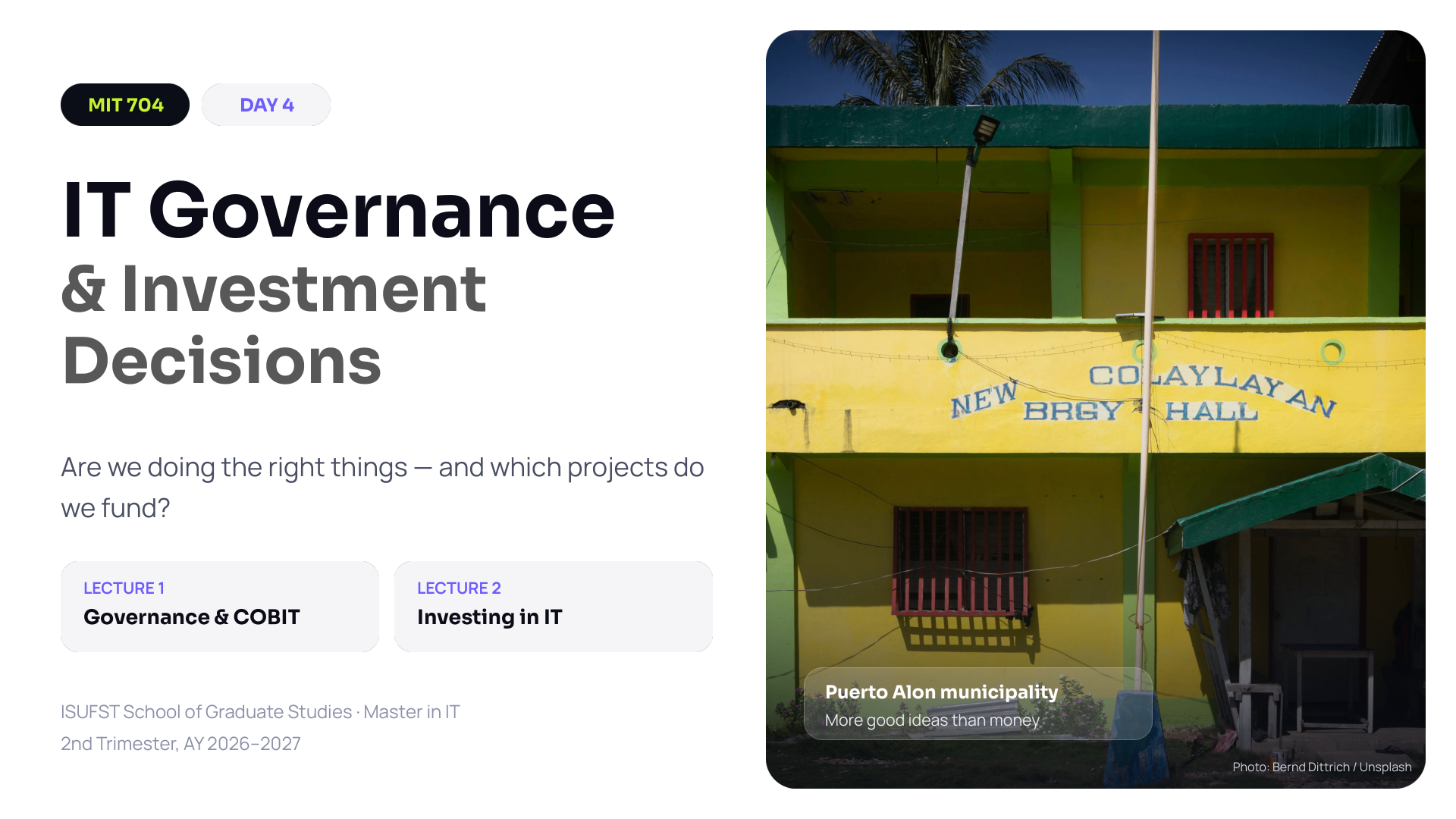
Review Tab 3 (Puerto Alon Exemplar). It demonstrates how a graduate team took the BantayBaybay Hackathon concept and produced full mathematical appraisals, matrices, and audit sign-offs.
Switch to Tab 4 (Blank Submission Form). Fill in your team's project details using the turnkey Markdown template. Use the 1-Click Copy Markdown or Download .md File buttons to save your work.
Explicit benefit chain connecting technical outputs to measurable public/citizen outcomes without vague generalities.
Defensible calculations (PERT durations, Payback, NPV, EVM, EMV, or TCO) with honest operational buffers.
Strict adherence to Philippine RA 9184 public procurement rules and COA asset capitalization guidelines.
Clear consideration of grassroots realities: device constraints (2G phones), local dialects, and operational stress.
Complete each deliverable for your team's Hackathon initiative. Check each item off as you complete your dossier.
Differentiate the Municipal Steering Committee's Governance role (Evaluate, Direct, Monitor) from the Technical Management role (Plan, Build, Run, Monitor).
Map Stakeholder Drivers → Enterprise Goals (EG01 Public Safety) → Alignment Goals (AG04 Real-time Telemetry) → Governance Objectives (EDM02, APO12, BAI03, MEA01).
Model full lifecycle expenditure across 5 years, proving that upfront CapEx is only ~45% of total cost and establishing recurring municipal OpEx appropriations.
Draft formal committee composition, voting quorum, decision rights, and bi-weekly milestone review protocols.
This is an authentic, graduate-level reference dossier illustrating how the BantayBaybay team executed Day 4. Use this as your benchmark for rigor, formatting, and depth.
The 5-year analysis revealed that upfront procurement (₱1.1M) was only 45.6% of the commitment. The municipal council was mandated to budget recurring annual appropriations: SIM cellular data (₱48k/yr) + Cloud database hosting (₱60k/yr) + Year 3 battery refresh (₱120k) + Maintenance retainers (₱130k/yr) = ₱2.41M Total 5-Year Ownership Cost.
Copy or download this pre-formatted Markdown template, fill in your team's Hackathon data, and submit for evaluation.
# [PROJECT NAME] — IT Governance, COBIT 2019 & 5-Year TCO Strategy
*(Continuation of Hackathon Project Charter · Round 1–4)*
**Team Name:** [Enter Hackathon Team Name]
**Academic Program:** MIT 704 · IT Project Management & Governance
**Sponsoring Entity:** [e.g., Municipal Agriculture Office / MDRRMO / Coastal Fisherfolk Federation]
**Primary Authors:** [Student Team Members & Designated Roles]
---
## 🧭 HACKATHON CONTINUITY BRIEF
*In Day 4, your team elevates your Hackathon project from a one-off technical build into a sustained institutional asset by establishing formal ISO/IEC 38500 governance, aligning with COBIT 2019 objectives, and modeling full 5-year operational lifecycle costs.*
---
## 1. Governance vs. Management Separation (ISO/IEC 38500)
* **Governance Body (Municipal IT Steering Committee):**
* **Evaluate:** Evaluates societal disaster risks, fisherfolk needs, and municipal budget constraints.
* **Direct:** Directs technical strategy via municipal executive orders, data privacy mandates, and funding appropriations.
* **Monitor:** Monitors benefits realization, COA statutory compliance, and casualty reduction metrics.
* **Management Body (Project Manager & ICT Office):**
* **Plan, Build, Run, Monitor (PBR):** Executes daily sprint delivery, oversees telemetry tower maintenance, monitors telco gateway health, and prepares operational status reports.
---
## 2. COBIT 2019 Goals Cascade Traceability Matrix
1. **Stakeholder Driver:** High mortality rate and boat capsizes among municipal fisherfolk during sudden sea squalls.
2. **Enterprise Goal (EG01):** Public safety and disaster resilience for coastal citizens (Aligned with Local Government Code Mandate).
3. **IT Alignment Goal (AG04):** Agile and resilient IT-enabled services delivering life-critical telemetry in real time.
4. **Selected Governance & Management Objectives:**
* **EDM02 (Ensured Benefits Realization):** Continuous tracking of emergency alert speed and casualty reduction.
* **APO12 (Managed Risk):** Redundant power, cellular tower failover, and battery theft countermeasures.
* **BAI03 (Solutions Identification & Build):** Modular sensor hardware and scalable cloud SMS architecture.
* **MEA01 (Managed Performance & Conformance):** Strict adherence to COA asset guidelines and RA 9184 procurement rules.
---
## 3. Five-Year Total Cost of Ownership (TCO) Modeler
*Upfront capital procurement represents less than half of an enterprise system's true financial commitment.*
| Cost Category | Year 1 (CapEx + OpEx) | Year 2 (OpEx) | Year 3 (OpEx + Refresh) | Year 4 (OpEx) | Year 5 (OpEx) | 5-Year Total |
| :--- | :---: | :---: | :---: | :---: | :---: | :---: |
| **Initial Hardware Procurement & Civil Works** | ₱940,000 | ₱0 | ₱0 | ₱0 | ₱0 | ₱940,000 |
| **Implementation Contingency Reserves** | ₱90,000 | ₱0 | ₱0 | ₱0 | ₱0 | ₱90,000 |
| **Management Reserve Envelope** | ₱70,000 | ₱0 | ₱0 | ₱0 | ₱0 | ₱70,000 |
| **Cellular SIM Cards & M2M Telemetry Data** | ₱48,000 | ₱48,000 | ₱48,000 | ₱48,000 | ₱48,000 | ₱240,000 |
| **Cloud Hosting & SMS Gateway Subscription** | ₱60,000 | ₱60,000 | ₱60,000 | ₱60,000 | ₱60,000 | ₱300,000 |
| **Quarterly Sensor Calibration & Tower Retainer** | ₱130,000 | ₱130,000 | ₱130,000 | ₱130,000 | ₱130,000 | ₱650,000 |
| **Mid-Life Battery & Solar Charge Controller Refresh**| ₱0 | ₱0 | ₱120,000 | ₱0 | ₱0 | ₱120,000 |
| **ANNUAL EXPENDITURE TOTALS** | **₱1,338,000** | **₱238,000** | **₱358,000** | **₱238,000** | **₱238,000** | **₱2,410,000** |
* **Key Governance Takeaway:** CapEx (₱1.1M) is only **45.6%** of 5-year TCO. Municipal appropriations must legally budget ₱238k–₱358k annually for operational sustainability.
See how your Hackathon concept advances across all 5 days of the ISUFST MIT 704 curriculum.
Establish statutory justification, 3-way options appraisal, 5-year NPV (+₱207k), and 26-week CPM baseline.
Form Scrum team, craft BDD acceptance criteria, define DoD quality contract, and size Sprint 1 (78 task hrs).
Price risk exposure with EMV, prioritize via RRL (>1.0), assign single-A RACI accountability, and enforce RA 9184 SLAs.
Separate governance (EDM) from management (PBR), trace COBIT Goals Cascade, and budget full ₱2.41M 5-year TCO.
Diagnose midterm EVM variance (CPI 0.92, SPI 0.80), execute live monsoon storm test, and capitalize fixed assets under COA rules.
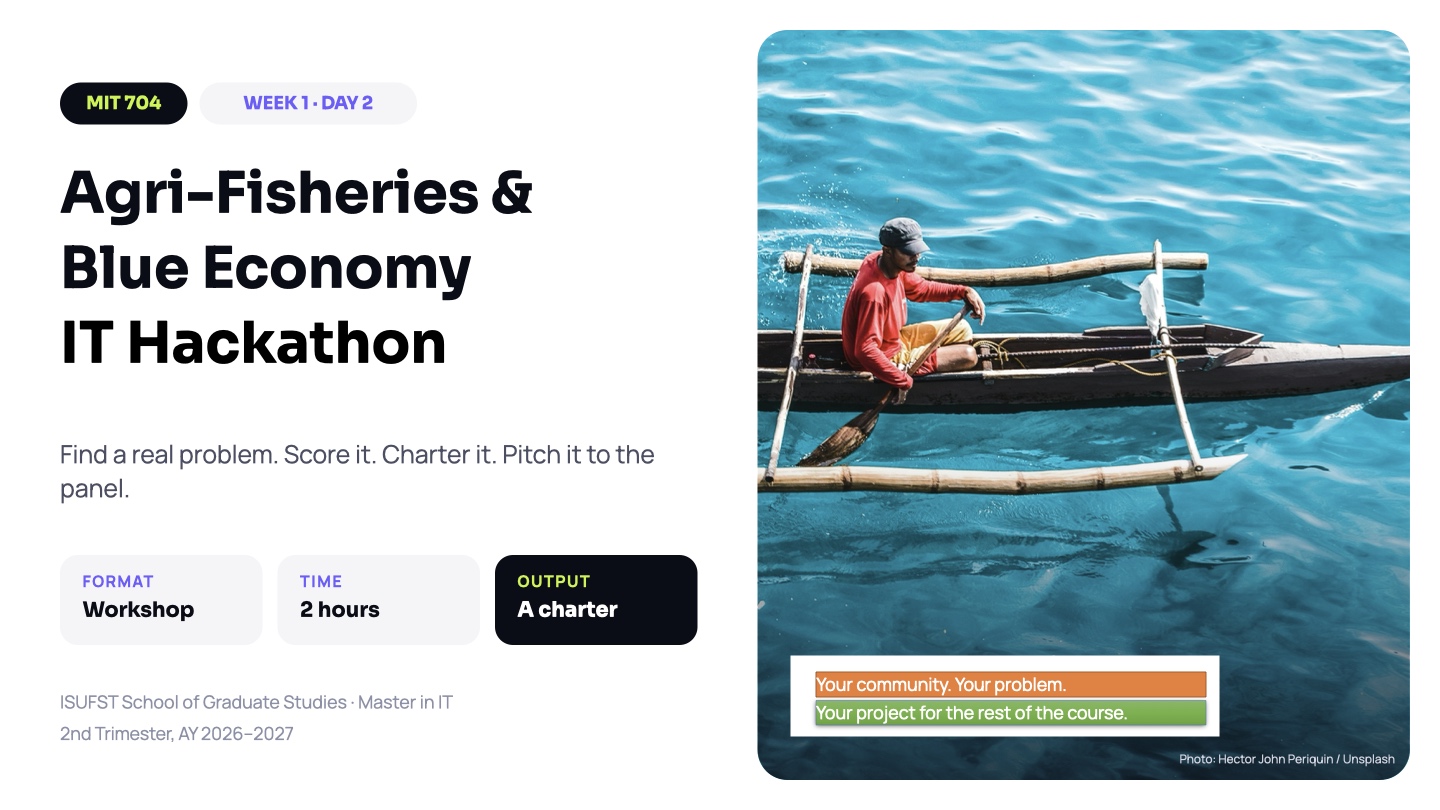
Teams of 3 to 5 graduate students working simultaneously across 3 workstreams. Every team develops and pitches one fundable, field-tested IT solution for Philippine artisanal agriculture or fisheries.
Open the class scoring spreadsheet and write five grassroots problems in your community. Every problem must be framed from the fisher's or farmer's point of view, backed with empirical field evidence (no jumping to solutions).
Score each problem 1 to 5 on the 6 weighted criteria. Before locking in the #1 winner, the team's designated Devil's Advocate delivers the strongest objection, and the team must defend it in one sentence.
Split into 3 workstreams to fill the 11-section Project Charter: SMART criteria, Level-2 WBS, System Context Diagram, Milestones, and a preliminary budget with a mandatory 10% contingency reserve.
3-minute 1-slide pitch to municipal stakeholder roles (Mayor, MAO, BFAR, Fisherfolk Co-op, ICT/DPO) followed by a 2-minute defense defending operational and financial feasibility.
If your team needs empirical inspiration, draw from these real-world coastal and rural municipal challenges:
• FishR and BoatR municipal registries severely out of date.
• Zero recorded catch logs for municipal waters under 15km.
• Late gale warnings fail to reach fishers without smartphone 4G.
• Red tide shellfish harvesting bans arrive after market dispatch.
• Farmers missing from RSBSA registry, blocking DA fuel subsidies.
• PCIC crop insurance claim verification stuck on physical paper.
• Armyworm and blast pest outbreaks reported days too late.
• Estuary water salinity and pH tested manually once a week.
• Ice-ice seaweed blight spreads without predictive environmental warning.
• Severe price asymmetry: fishers sell at buyer price without market feeds.
• 30% post-harvest loss from inadequate ice logistics at municipal piers.
• Thousands of mangrove saplings planted with zero survival monitoring.
• Marine Protected Area (MPA) patrol logs kept on paper notebooks.
| Criterion | Weight | Anchor: Score 1 (Weak) | Anchor: Score 5 (Exemplary) |
|---|---|---|---|
| Livelihood Impact | 25% | Touches <20 households; minor economic inconvenience | Directly protects hundreds of livelihoods, food security, or life safety |
| Feasibility | 20% | Requires unavailable satellite arrays or 4G LTE at sea | Feasible in 12 months using 2G SMS, solar batteries, and local LGU staff |
| Urgency & Vulnerability | 15% | Can wait 3 years with negligible public impact | Critical immediate hazard: loss of life, harvest failure, or stock collapse |
| Sustainability & Climate | 15% | Zero ecological or climate resilience benefit | Directly reduces disaster risk, preserves fish stocks, or restores mangroves |
| Data Readiness | 15% | No registries exist; Data Privacy Act compliance impossible | Empirical registries exist (FishR, RSBSA) and are legally accessible |
| Policy Alignment | 10% | Not mentioned in any municipal or national plans | Explicitly prioritized in LGU AIP, Coastal Resource Plan, or BFAR mandate |
The project chosen today does not end today. Here is exactly how your team will advance this exact project across Days 2 to 5:
Problem discovery, SMART success criteria, 1-box Context Boundary, 3-level WBS, Three-Point PERT, 26-week Critical Path & 10% Reserves.
Decompose the Charter into Scrum Epics, write BDD User Stories for Mang Ramon & Ate Liza, and calculate 78 focus hours for Sprint 1.
Score typhoon and political risks with EMV ($P imes I$), prove Risk Reduction Leverage (RRL > 1.0), and establish RA 9184 SLA penalty clauses.
Align project with municipal objectives using COBIT Goals Cascade, calculate the 5-Year TCO Iceberg (CapEx vs OpEx), and score against portfolio competitors.
Conduct Month 3 EVM audit ($PV, EV, AC, CPI, SPI, EAC$), execute crisis schedule crashing during typhoons, and execute COA asset capitalization handover.
ISUFST School of Graduate Studies · Master in Information Technology · BantayBaybay Puerto Alon Framework
Foundations of public-sector IT investment appraisal, strategic benefit chains, and predictive scope planning for the BantayBaybay Puerto Alon early-warning network.
Distinguishing capital initiatives from ongoing IT operations; establishing the PM accountability boundary (Outputs vs Capabilities vs Outcomes vs Strategic Benefits).
Financial justification models, options analysis under LGU fiscal constraints, and hierarchical decomposition into Work Breakdown Structures.
Translating municipal requirements into INVEST-compliant user stories, Given-When-Then BDD acceptance tests, story point sizing, and probabilistic velocity burndown.
Empirical process control (Transparency, Inspection, Adaptation), Scrum 3 accountabilities, INVEST backlog decomposition, and Behavior-Driven Development (BDD).
Separating effort from duration using relative story points, historical velocity forecasting, team focus factor, and real-time burndown tracking.
Mitigating supply chain and community risks in municipal IT projects, pricing risk quantitatively with Expected Monetary Value (EMV), Philippine RA 9184 compliance, and cross-functional RACI matrices.
Systematic hazard taxonomy, probability-impact rating, quantitative Expected Monetary Value (EMV), and sizing contingency vs management reserves.
Engaging fisherfolk cooperatives and MDRRMO officials, navigating Philippine public procurement (RA 9184), vendor SLAs, and organizational RACI governance.
Aligning municipal IT investments to LGU strategic vision, implementing the COBIT 2019 Goals Cascade, modeling 5-Year Total Cost of Ownership (TCO), and IT Balanced Scorecard prioritization.
Distinguishing enterprise governance from management; applying the COBIT 2019 Goals Cascade to map municipal stakeholder needs into concrete IT objectives.
Holistic lifecycle financial analysis factoring recurring cellular telemetry, solar battery replacement, cloud compute, maintenance contracts, and IT Balanced Scorecards.
Executing Earned Value Management (EVM) to detect project drift, executing midpoint recovery, validating resiliency during the Typhoon Ambo trial deployment, and formal administrative closure.
Tracking objective work progress using Planned Value ($PV$), Earned Value ($EV$), and Actual Cost ($AC$); diagnosing cost/schedule variances and forecasting final completion costs ($EAC$).
Validating sensor telemetry under extreme typhoon weather, executing formal administrative closeout, asset handover to MDRRMO, and conducting Post-Implementation Reviews.
Select any day below to inspect its academic curriculum, lecture breakdown, deliverables, and launch its interactive module.