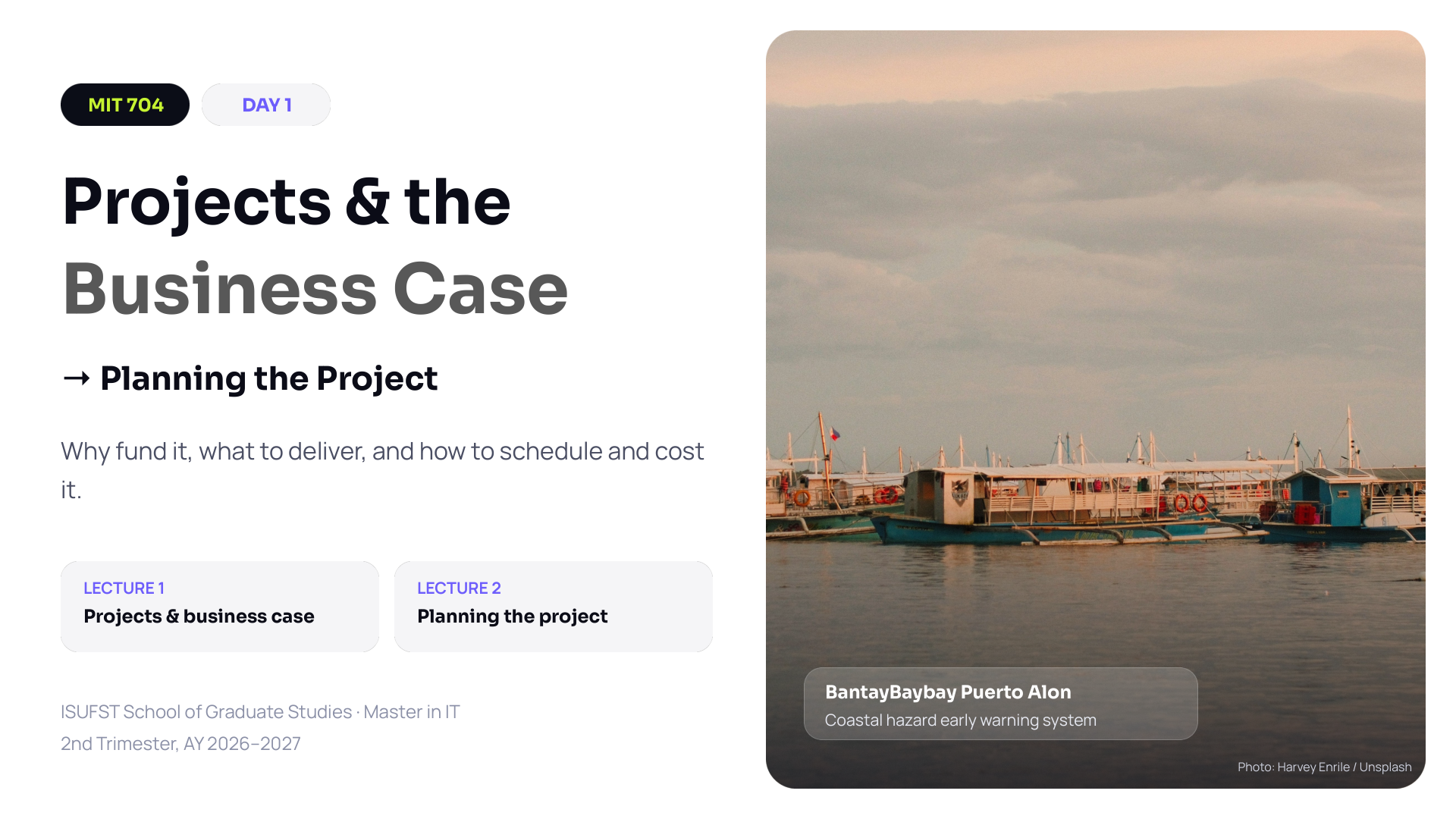
MIT 704
IT Project Management & Governance
ISUFST School of Graduate Studies · Master in Information Technology
Slide 1
Slide: 0:00 / 1:00 Module: 0:00 / 61:44 (0%)
Slide 1 of 55
Lecture 1 · Predictive Initiation & Scope Baseline

Projects, The Business Case & Planning

BantayBaybay Puerto Alon Case Study

Core Executive Insight

⚡ Decision Studio · Quantitative Initiation & Planning Workbench

Day 1 High-Yield Financial Appraisal, Three-Point PERT & Work Breakdown Structure Estimator

3 Interactive Quantitative Models
Lecture 1 · Capital Budgeting & Economic Appraisal

Simulate capital budgeting for Option B (Hybrid Cloud + Solar Telemetry) against municipal fiscal hurdles.

Simple Payback Period 3.19 Yrs Hurdle Target: ≤ 4.0 Years
5-Year Net Present Value (NPV) +₱207,820 Discounted at r = 10%
Return on Investment (ROI %) +56.8% Over 5-Year Cumulative Horizon
Executive Investment Recommendation
RECOMMENDED FOR SANGGUNIANG BAYAN APPROPRIATION
STEP-BY-STEP MATHEMATICAL CALCULATION BREAKDOWN Exact Case Study Formulas
Standard Formulas: Payback = C₀ / B  |  NPV = Σ [ B / (1+r)ᵗ ] - C₀  |  ROI = [ (5 × B - C₀) / C₀ ] × 100%
1. Authoritative Lecture Benchmark
CapEx C₀:₱1,100,000
Annual Benefit B:₱345,000 / year
Simple Payback:1,100,000 / 345,000 = 3.19 Years
5-Year Cumulative:5 × 345,000 = ₱1,725,000
Lecture 5-Yr NPV:+₱207,820 (Approved)
2. Live Dynamic Equation
Payback Equation:₱1,100,000 / ₱345,000 = 3.19 Years
Cumulative 5-Yr Net:5(₱345k) - ₱1.1M = +₱625,000
Discounted Cash Inflow:Σ PV(Bt) = ₱1,307,820
Live Net Present Value:₱1,307,820 - ₱1,100,000 = +₱207,820
Live ROI %:(₱625,000 / ₱1,100,000) × 100 = +56.8%
Lecture 1 · Schedule Estimation & Critical Path Method

Beta Distribution PERT Estimation: Expected Duration Tₑ = (o + 4m + p) / 6 and Variance σ² = ((p - o) / 6)².

Expected Duration (Tₑ) 26.0 wks Weighted Beta Mean
Standard Deviation (σ) 4.00 wks σ = (p - o) / 6
Schedule Variance (σ²) 16.00 Additive Path Variance
Delivery Confidence Windows
68% confidence: 22.0 to 30.0 weeks. 95% ceiling: 34.0 weeks.
STEP-BY-STEP MATHEMATICAL CALCULATION BREAKDOWN Exact PERT Beta Equations
Formulas: Tₑ = (o + 4m + p) / 6  |  σ = (p - o) / 6  |  σ² = ((p - o) / 6)²  |  95% Buffer = Tₑ + 2σ
1. Authoritative Lecture Benchmark
Optimistic (o):16 weeks (Dry season, no supplier delays)
Most Likely (m):25 weeks (Normal civil & sensor pace)
Pessimistic (p):40 weeks (Severe monsoon + supply lag)
Calculation:[ 16 + 4(25) + 40 ] / 6 = 156 / 6 = 26.0 wks
Spread & Variance:σ = (40 - 16)/6 = 4.0 wks  |  σ² = 16.0
2. Live Dynamic Equation
Formula Substitution:[ 16 + 4(25) + 40 ] / 6
Numerator Sum:156
Expected Duration Tₑ:26.00 weeks
Std Deviation σ:(40 - 16) / 6 = 4.00 wks
Variance σ²:(4.00)² = 16.00
Lecture 1 · Work Breakdown Structure Cost Accounting

Statutory Cost Baseline Architecture: Direct Work Packages + Contingency Reserves = Cost Baseline. Baseline + Management Reserves = Total Project Budget.

Approved Cost Baseline ₱1,030,000 Direct Packages + Contingency
Total Project Budget (BAC) ₱1,100,000 Cost Baseline + Mgmt Reserve
Reserve Ratio % 14.5% Healthy Public Buffer: 10–18%
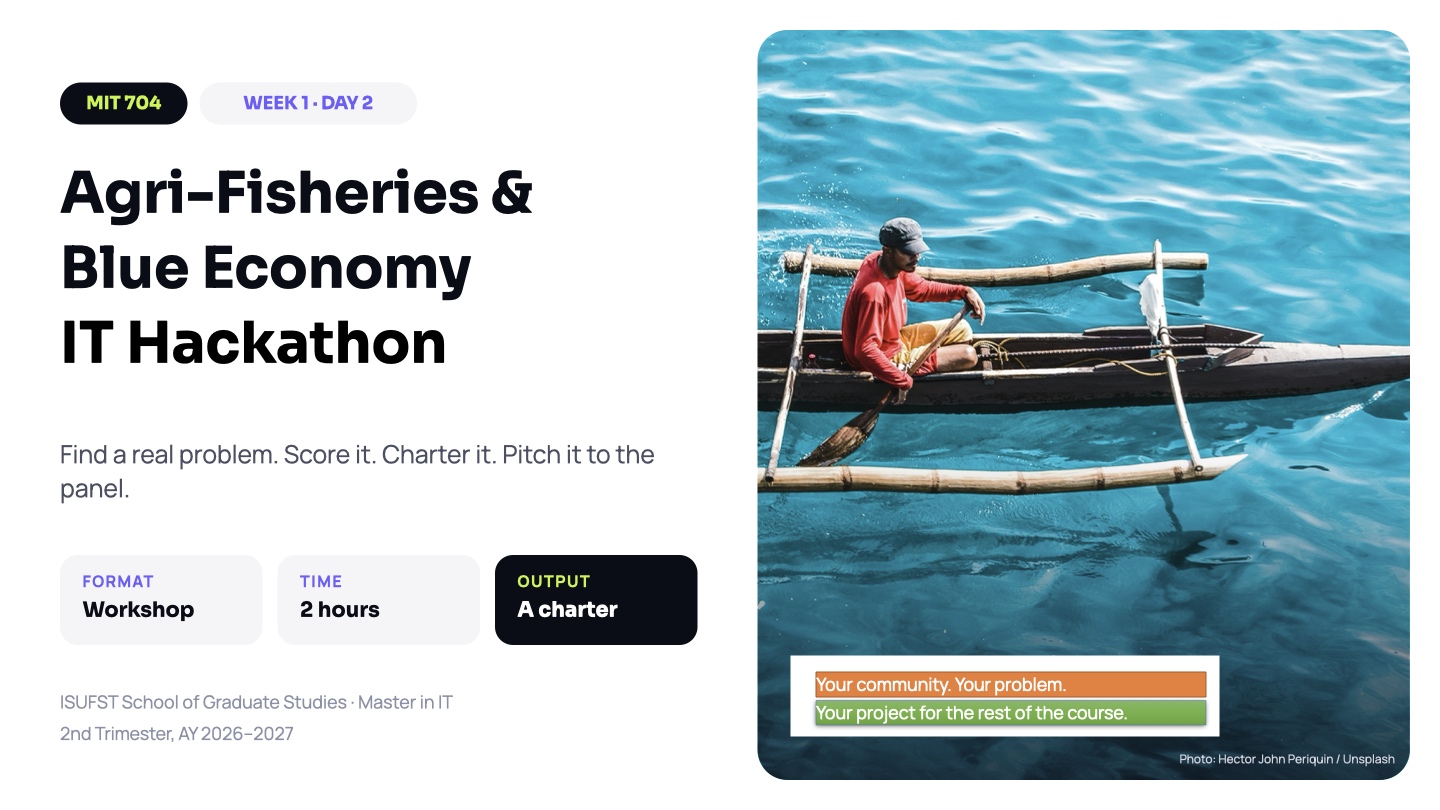
Hackathon Continuation Project Phase 1 · Project Initiation & Business Case

Day 1 Executive Project Blueprint & Submission Guide

Direct Step-by-Step Continuation of Your Agri-Fisheries IT Hackathon Project

🌱 Connecting Your Hackathon Project to Day 1

CRITICAL INSTRUCTION: Do not invent a new, disconnected project topic. During the Agri-Fisheries IT Hackathon Workshop, your student team selected a real-world coastal or agricultural hazard and produced an initial Hackathon Project Charter (e.g., LandingWatch, BantayBaybay, PalayTrust, AgriTrack).

In Day 1: Initiation, Business Case & Scope Baseline, your team takes that exact same project charter and advances it through today's graduate-level governance stage. Every day in this 5-day curriculum builds one unified, audit-ready master project dossier!

📋 Step-by-Step Instructions: What To Do Today
1
Retrieve Your Hackathon Project Charter

Open your team's Hackathon Charter from the Hackathon Panel above. Identify your selected Problem Statement, Target Beneficiary Group, and Core Technical Innovation.

2
Review the Required Day 1 Deliverables in Tab 2

Check the checklist in Tab 2 (Deliverables Checklist & Rubric). It provides clear instructions, formulas, and quality criteria for each section you must produce.

3
Examine the Worked Reference Exemplar in Tab 3

Review Tab 3 (Puerto Alon Exemplar). It demonstrates how a graduate team took the BantayBaybay Hackathon concept and produced full mathematical appraisals, matrices, and audit sign-offs.

4
Complete & Export the Submission Form in Tab 4

Switch to Tab 4 (Blank Submission Form). Fill in your team's project details using the turnkey Markdown template. Use the 1-Click Copy Markdown or Download .md File buttons to save your work.

🎯 Graduate Grading Rubric & Success Anchors
1. Strategic Traceability (25%)

Explicit benefit chain connecting technical outputs to measurable public/citizen outcomes without vague generalities.

2. Quantitative Rigor (25%)

Defensible calculations (PERT durations, Payback, NPV, EVM, EMV, or TCO) with honest operational buffers.

3. Regulatory Compliance (25%)

Strict adherence to Philippine RA 9184 public procurement rules and COA asset capitalization guidelines.

4. Human-Centered Design (25%)

Clear consideration of grassroots realities: device constraints (2G phones), local dialects, and operational stress.

📝 Day 1 Required Project Submissions

Complete each deliverable for your team's Hackathon initiative. Check each item off as you complete your dossier.

Deliverable 1.1 · Executive Project Charter & Benefit Chain Required

Extract your problem statement from Hackathon Charter Round 1. Map the complete Benefit Chain: Technical Outputs → Operational Capabilities → Citizen Outcomes → Strategic Municipal Benefits.

Deliverable 1.2 · 3-Way Economic Options Appraisal Required

Compare Option A (Status Quo / Manual), Option B (Your Hackathon Solution), and Option C (High-End Commercial Alternative) across upfront CapEx, annual OpEx, warning speed, and payback period.

Deliverable 1.3 · Financial Appraisal: Payback & 5-Year NPV Required

Calculate the simple payback period ($ ext{Payback} = ext{CapEx} / ext{Annual Benefit}$) and discounted Net Present Value at 10% discount rate over 5 years. Prove capital recovery is within acceptable municipal thresholds.

Deliverable 1.4 · Scope Baseline & In/Out-of-Scope Boundaries Required

Document explicit inclusions and at least three explicit exclusions (e.g. acoustic sirens or hardware subsidies deferred to Phase 2) to protect your team from political scope creep.

Deliverable 1.5 · 3-Level Work Breakdown Structure (WBS) Required

Hierarchical deliverable decomposition satisfying the 100% Rule and 8-to-80 hour work package sizing criteria across procurement, hardware, software, and handover.

Deliverable 1.6 · Three-Point PERT & Critical Path Network Required

Calculate expected duration $T_e = (O + 4M + P)/6$ for all work activities, determine precedence dependencies, identify activity float, and highlight the zero-float Critical Path.

Deliverable 1.7 · Cost Baseline & Two-Tier Reserves Allocation Required

Separate PM-managed Contingency Reserves (for identified risk events) from Sponsor-managed Management Reserves (for unforeseen municipal emergencies) above the Cost Baseline.

🏆 Gold-Standard Worked Reference Exemplar: BantayBaybay Puerto Alon

This is an authentic, graduate-level reference dossier illustrating how the BantayBaybay team executed Day 1. Use this as your benchmark for rigor, formatting, and depth.

1. BantayBaybay Option B Justification & Benefit Chain
Option Upfront CapEx Warning Speed Payback Period 5-Year NPV (@ 10%) Verdict
Option A (Manual Radio) ₱0 45–90 mins N/A Negative Rejected (Inadequate safety)
Option B (Hybrid Cloud + Solar) ₱1,100,000 6.4 mins 3.19 years +₱207,820 RECOMMENDED
Option C (Commercial Satellite) ₱2,400,000 5.0 mins 6.95 years -₱412,000 Rejected (Unsustainable OpEx)
2. BantayBaybay 26-Week Critical Path Precedence Network

The PERT calculation established the 26-week statutory critical path anchored by RA 9184 competitive procurement (ACT-01, 6.3 wks) → Sensor tower civil foundation works (ACT-02, 5.2 wks) → Telemetry & solar installation (ACT-03, 3.3 wks) → Integrated field stress testing (ACT-05, 3.0 wks) → Final COA handover audit (ACT-06, 2.0 wks). Non-critical software development (ACT-04, 3.2 wks) possessed 2.0 weeks of total float.

📄 Turnkey Project Submission Template

Copy or download this pre-formatted Markdown template, fill in your team's Hackathon data, and submit for evaluation.

# [PROJECT NAME] — IT Project Initiation & Scope Baseline Charter
*(Continuation of Hackathon Project Charter · Round 1–4)*
**Team Name:** [Enter Hackathon Team Name]
**Academic Program:** MIT 704 · IT Project Management & Governance
**Sponsoring Entity:** [e.g., Municipal Agriculture Office / MDRRMO / Coastal Fisherfolk Federation]
**Primary Authors:** [Student Team Members & Designated Roles]

---

## 🧭 HACKATHON CONTINUITY BRIEF
* **Selected Problem Statement:** [Copy from Hackathon Charter Round 1: Specific coastal/agricultural vulnerability addressed]
* **Target Beneficiaries:** [e.g., 2,100 municipal small-scale fisherfolk, 8 coastal barangays, local municipal disaster council]
* **Proposed Technical Innovation:** [Copy from Hackathon Charter Round 2: Core hardware/software architecture]

---

## 1. Benefit Chain Alignment (Strategic Traceability)
*Every graduate IT project must demonstrate statutory value before spending public funds.*
* **Outputs (Delivered by Technical Team):** [e.g., 6 solar telemetry stations with sea-level sensors and an automated SMS broadcast gateway installed]
* **Capabilities (Delivered by Technical Team):** [e.g., Ability to detect tidal storm surges and broadcast targeted hazard warnings to 2,000+ mobile numbers within 3 minutes]
* **Outcomes (Achieved by Operational Users & Citizens):** [e.g., Coastal fisherfolk receive early warnings and dock boats safely ashore before gale-force squalls hit]
* **Strategic Benefits (Achieved by Municipality / Enterprise):** [e.g., Zero fisherfolk casualties at sea, ₱1.8M annual savings in municipal search-and-rescue emergency expenditures]

---

## 2. Three-Way Options Appraisal & Economic Business Case
| Appraisal Criteria | Option A: Status Quo / Manual | Option B: Hybrid Cloud + Solar Telemetry (Recommended) | Option C: Commercial Satellite Network |
| :--- | :--- | :--- | :--- |
| **Capital Outlay (CapEx)** | ₱0 upfront | ₱1,100,000 | ₱2,400,000 |
| **Annual Operating Cost (OpEx)** | ₱450,000 (Search & rescue, fuel) | ₱150,000 / year (SIMs, cloud, battery maintenance) | ₱680,000 / year (Recurring satellite bandwidth fees) |
| **Warning Dissemination Speed** | 2 to 6 hours (Manual relays) | 3 to 7 minutes (Automated SMS dispatch) | 2 to 5 minutes |
| **Simple Payback Period** | N/A (Net ongoing liability) | **3.19 Years** [(CapEx ₱1.1M) / (Annual Net Benefit ₱345k)] | 6.95 Years |
| **5-Year NPV (@ 10% Discount Rate)** | Negative cash flow | **+₱207,820** | -₱412,000 |
| **Delivery Risk & Vendor Dependency**| High risk of loss of life | Moderate (Standard GSM telco APIs & local solar works) | High (Single proprietary foreign satellite vendor) |
| **Recommendation Verdict** | **REJECTED** (Unacceptable public safety risk) | **RECOMMENDED** (Optimal balance of speed, cost, and payback) | **REJECTED** (Unsustainable recurring municipal OpEx) |

---

## 3. Scope Baseline & Work Breakdown Structure (WBS)
### 3.1 Explicit In-Scope Boundaries
* **Deliverable 1 (Civil & Sensor Works):** Installation of 6 galvanized telemetry masts with solar panels, deep-cycle AGM batteries, and ultrasonic sea-level sensors.
* **Deliverable 2 (Software Broadcast Pipeline):** Cloud dispatch server, telco aggregator SMS API integration, and emergency web console for MDRRMO dispatchers.
* **Deliverable 3 (Operational Handover):** Bilingual alert templates (Hiligaynon/Tagalog), operator SOP manuals, and municipal validation drill.

### 3.2 Explicit Scope Exclusions (Protecting Against Scope Creep)
* **Exclusion 1:** Acoustic sirens and loudspeaker towers (deferred to municipal Phase 2 expansion).
* **Exclusion 2:** Individual boat-mounted GPS transponders (individual vessel equipment is out-of-scope for municipal infrastructure).
* **Exclusion 3:** Subsidized smartphones for fishermen (system strictly leverages existing 2G keypad phones).

### 3.3 Three-Level Work Breakdown Structure (Adhering to 100% Rule)
* **1.0 [Project Name] Implementation**
  * **1.1 Project Governance & Statutory Procurement**
    * 1.1.1 Project Charter & Stakeholder Alignment Protocol
    * 1.1.2 RA 9184 Competitive Bidding & Vendor Contracts
  * **1.2 Physical Telemetry Infrastructure**
    * 1.2.1 Coastal Mast Foundation Civil Works & Concrete Curing
    * 1.2.2 Solar Panel, Charge Controller & Battery Bank Rigging
    * 1.2.3 Sea-Level & Barometric Pressure Sensor Calibration
  * **1.3 Software & Communications Infrastructure**
    * 1.3.1 Telco SMS Gateway API Integration & Shortcode Setup
    * 1.3.2 Dispatcher Web Dashboard & Geo-Targeted Alert Pipeline
    * 1.3.3 End-to-End Latency & Load Testing
  * **1.4 Training, Verification & Handover**
    * 1.4.1 Barangay Captain & Operator Protocol Drills
    * 1.4.2 COA Inspection, Asset Tagging & Certificate of Acceptance

---

## 4. Precedence Network & Critical Path Method (Three-Point PERT)
\$\$\text{Expected Duration } T_e = \frac{O + 4M + P}{6} \qquad \text{Standard Deviation } \sigma = \frac{P - O}{6}\$\$

| Activity ID | Activity Description | Opt (O) | Likely (M) | Pess (P) | PERT \$T_e\$ | Predecessors | Total Float | Critical? |
| :--- | :--- | :---: | :---: | :---: | :---: | :---: | :---: | :---: |
| **ACT-01** | RA 9184 Public Bidding & Contract Award | 4 wks | 6 wks | 10 wks | **6.3 wks** | None | 0 wks | **YES (Critical)** |
| **ACT-02** | Mast Civil Foundation & Concrete Curing | 3 wks | 5 wks | 8 wks | **5.2 wks** | ACT-01 | 0 wks | **YES (Critical)** |
| **ACT-03** | Sensor Telemetry & Solar Power Rigging | 2 wks | 3 wks | 6 wks | **3.3 wks** | ACT-02 | 0 wks | **YES (Critical)** |
| **ACT-04** | SMS Gateway Software & Dispatch Console | 2 wks | 3 wks | 5 wks | **3.2 wks** | ACT-01 | 2.0 wks | NO (Float = 2 wks)|
| **ACT-05** | Integrated Field Stress Test & Drill | 2 wks | 3 wks | 4 wks | **3.0 wks** | ACT-03, ACT-04 | 0 wks | **YES (Critical)** |
| **ACT-06** | COA Audit Inspection & Final Handover | 1 wk | 2 wks | 3 wks | **2.0 wks** | ACT-05 | 0 wks | **YES (Critical)** |

* **Total Critical Path Duration:** **19.8 Weeks (~5.0 Months)**. Any delay in ACT-01, ACT-02, ACT-03, ACT-05, or ACT-06 causes an immediate day-for-day slippage of final system go-live.

---

## 5. Cost Baseline & Two-Tier Reserves Allocation
* **Direct Work Packages Base Cost:** ₱940,000 (Detailed BOM: sensors, towers, cloud setup, training)
* **Contingency Reserve (Known Unknowns):** ₱90,000 (9.6% · Managed directly by Project Manager for identified risks like weather delays)
* **TOTAL COST BASELINE:** **₱1,030,000**
* **Management Reserve (Unknown Unknowns):** ₱70,000 (Requires formal Municipal Mayor & Council approval for unforeseen emergencies)
* **TOTAL APPROVED CAPITAL BUDGET ENVELOPE:** **₱1,100,000**

🗺️ The Continuous 5-Day Project Lifecycle

See how your Hackathon concept advances across all 5 days of the ISUFST MIT 704 curriculum.

Day 1 Initiation
Projects, Business Case & WBS

Establish statutory justification, 3-way options appraisal, 5-year NPV (+₱207k), and 26-week CPM baseline.

Day 2 Agile
Scrum, Backlog & Sprints

Form Scrum team, craft BDD acceptance criteria, define DoD quality contract, and size Sprint 1 (78 task hrs).

Day 3 Governance
Risk, RACI & Procurement

Price risk exposure with EMV, prioritize via RRL (>1.0), assign single-A RACI accountability, and enforce RA 9184 SLAs.

Day 4 Enterprise
COBIT 2019 & 5-Year TCO

Separate governance (EDM) from management (PBR), trace COBIT Goals Cascade, and budget full ₱2.41M 5-year TCO.

Day 5 Closure
EVM Control, Stress-Test & COA

Diagnose midterm EVM variance (CPI 0.92, SPI 0.80), execute live monsoon storm test, and capitalize fixed assets under COA rules.

Day 1 Activity · 5-Day Capstone
Agri-Fisheries & Blue Economy IT Hackathon
Hackathon Slide Preview
Slide 1 of 36
Slide 1 of 36 Agri-Fisheries & Blue Economy IT Hackathon

⚡ Workshop Structure: 2-Hour Action Sprint

Teams of 3 to 5 graduate students working simultaneously across 3 workstreams. Every team develops and pitches one fundable, field-tested IT solution for Philippine artisanal agriculture or fisheries.

Round 1 Problem Storm (15m)

Open the class scoring spreadsheet and write five grassroots problems in your community. Every problem must be framed from the fisher's or farmer's point of view, backed with empirical field evidence (no jumping to solutions).

Round 2 Score & Select (15m)

Score each problem 1 to 5 on the 6 weighted criteria. Before locking in the #1 winner, the team's designated Devil's Advocate delivers the strongest objection, and the team must defend it in one sentence.

Round 3 Charter Sprint (35m)

Split into 3 workstreams to fill the 11-section Project Charter: SMART criteria, Level-2 WBS, System Context Diagram, Milestones, and a preliminary budget with a mandatory 10% contingency reserve.

Round 4 Panel Pitch (5m)

3-minute 1-slide pitch to municipal stakeholder roles (Mayor, MAO, BFAR, Fisherfolk Co-op, ICT/DPO) followed by a 2-minute defense defending operational and financial feasibility.

If your team needs empirical inspiration, draw from these real-world coastal and rural municipal challenges:

🐟 Municipal Fisheries

• FishR and BoatR municipal registries severely out of date.
• Zero recorded catch logs for municipal waters under 15km.
• Late gale warnings fail to reach fishers without smartphone 4G.
• Red tide shellfish harvesting bans arrive after market dispatch.

🌾 Agriculture & Smallholders

• Farmers missing from RSBSA registry, blocking DA fuel subsidies.
• PCIC crop insurance claim verification stuck on physical paper.
• Armyworm and blast pest outbreaks reported days too late.

🌊 Aquaculture & Seaweed

• Estuary water salinity and pH tested manually once a week.
• Ice-ice seaweed blight spreads without predictive environmental warning.

⚖️ Landing Sites & Cold Chain

• Severe price asymmetry: fishers sell at buyer price without market feeds.
• 30% post-harvest loss from inadequate ice logistics at municipal piers.

🌿 Mangroves & MPA Ecology

• Thousands of mangrove saplings planted with zero survival monitoring.
• Marine Protected Area (MPA) patrol logs kept on paper notebooks.

Criterion Weight Anchor: Score 1 (Weak) Anchor: Score 5 (Exemplary)
Livelihood Impact 25% Touches <20 households; minor economic inconvenience Directly protects hundreds of livelihoods, food security, or life safety
Feasibility 20% Requires unavailable satellite arrays or 4G LTE at sea Feasible in 12 months using 2G SMS, solar batteries, and local LGU staff
Urgency & Vulnerability 15% Can wait 3 years with negligible public impact Critical immediate hazard: loss of life, harvest failure, or stock collapse
Sustainability & Climate 15% Zero ecological or climate resilience benefit Directly reduces disaster risk, preserves fish stocks, or restores mangroves
Data Readiness 15% No registries exist; Data Privacy Act compliance impossible Empirical registries exist (FishR, RSBSA) and are legally accessible
Policy Alignment 10% Not mentioned in any municipal or national plans Explicitly prioritized in LGU AIP, Coastal Resource Plan, or BFAR mandate
LandingWatch Exemplar · 11-Section Turnkey Markdown Template
# PROJECT CHARTER: LandingWatch (BantayBaybay) ## Same-Day Fish Prices & Catch Records for Municipal Landing Sites ### 1. Project Identity - **Project Code:** MIT704-HACK-G01 - **Project Title:** LandingWatch Municipal Telemetry & SMS Dispatch - **Target Location:** Barangay Puerto Alon & Barangay San Pedro Landing Piers - **Sponsoring Agency:** Municipal Agriculture Office (MAO) & MFARMC ### 2. Problem Statement & Evidence - **Grassroots Problem:** Small-scale fishers sell their catch at whatever price the local middleman dictates because market prices are posted on paper 24 hours too late. - **Field Evidence:** 620 registered fishers; 0 digital catch logs; 18% estimated loss in gross fisher income due to pricing opacity; 84% of fishers own basic 2G feature phones. ### 3. SMART Success Criteria - **S1:** At least 70% of registered municipal fishers receive daily 5:00 AM SMS market prices by Month 4. - **S2:** At least 90% of boat catch landings logged digitally within 2 hours of arrival by Month 6. - **S3:** Average net income realized by participating fishers increases by 10% within 12 months. ### 4. Scope Envelope - **IN SCOPE:** • Dual-channel SMS gateway (2G basic phones + Android PWA for landing marshals) • Solar-powered digital scale integration at 2 pilot landing sites • Daily market price broadcast engine connecting to municipal agriculture board - **OUT OF SCOPE:** • Satellite broadband on bangkas at sea • Mobile e-wallet payment processing (deferred to Phase 2) • Cold storage refrigeration physical construction ### 5. System Context Boundary Diagram ```mermaid graph TD Fishers["Municipal Fishers (2G SMS)"] -- Catch Query & Daily Price --> Sys["LandingWatch System"] Marshals["Pier Landing Marshals"] -- Weight & Species Entry --> Sys MAO["Municipal Agriculture Officer"] -- Price Board Configuration --> Sys BFAR["BFAR Region VI"] <-- Aggregated Monthly Catch Telemetry -- Sys ``` ### 6. Work Breakdown Structure (Level 2) - **1.0 Project Management:** Charter, Stakeholder Alignment, RA 9184 SLA Procurement - **2.0 Hardware & Pier Setup:** Solar Digital Scales, Ruggedized Tablet Enclosures, Surge Protection - **3.0 Software & Telco Gateway:** SMS Broadcast Engine, Landing Marshal Web App, Offline Sync - **4.0 User Training & Rollout:** Marshal Field Drills, Fisher SMS Awareness Campaign, Go-Live - **5.0 Governance & Post-Handover:** COA Property Capitalization, Post-Implementation Review ### 7. Milestones & Schedule - **M1:** Charter Signed & Council Resolution: Month 1 - **M2:** Hardware Procured & Pier Scales Installed: Month 3 - **M3:** SMS Gateway Live Field Pilot: Month 4 - **M4:** 100% Landing Catch Data Recorded: Month 6 - **M5:** COA Property Transfer & Operations Handover: Month 7 ### 8. Preliminary Budget & Reserves - **Hardware & Scales:** ₱145,000 - **Software Development & SMS Bundles:** ₱120,000 - **Marshal Training & Field Drills:** ₱26,000 - **Subtotal (Base Cost):** ₱291,000 - **Contingency Reserve (10% Known Unknowns):** ₱29,100 - **TOTAL APPROVED BUDGET:** ₱320,100 - **Annual Recurring OpEx:** ₱72,000 / year (funded via LGU AIP) ### 9. Key Risks & Approvals - **Risk 1:** Cellular tower power loss during severe monsoon storms. (Mitigation: Offline store-and-forward SQLite database). - **Risk 2:** Fisher distrust of digital scales. (Mitigation: MFARMC joint calibration verification seal). - **Executive Sign-off:** Municipal Mayor, Municipal Agriculturist, MFARMC Chairman.

🔄 Slide 34 Rule: Course-Long Continuous Spine

The project chosen today does not end today. Here is exactly how your team will advance this exact project across Days 2 to 5:

Day 1: Project Alignment & WBS

Problem discovery, SMART success criteria, 1-box Context Boundary, 3-level WBS, Three-Point PERT, 26-week Critical Path & 10% Reserves.

Day 2: Agile Sprints & Backlog

Decompose the Charter into Scrum Epics, write BDD User Stories for Mang Ramon & Ate Liza, and calculate 78 focus hours for Sprint 1.

Day 3: Quantitative Risk & RACI

Score typhoon and political risks with EMV ($P imes I$), prove Risk Reduction Leverage (RRL > 1.0), and establish RA 9184 SLA penalty clauses.

Day 4: COBIT 2019 & 5-Year TCO

Align project with municipal objectives using COBIT Goals Cascade, calculate the 5-Year TCO Iceberg (CapEx vs OpEx), and score against portfolio competitors.

Day 5: EVM Analytics & Handover

Conduct Month 3 EVM audit ($PV, EV, AC, CPI, SPI, EAC$), execute crisis schedule crashing during typhoons, and execute COA asset capitalization handover.

Curriculum Slide Index
55 Slides · 61m 44s Total Runtime